
Compare Buckingham Property Values
One Buckingham parcel can carry several values at once. They are not interchangeable. The Commissioner of Revenue assesses property for local taxation. That number drives the tax roll. A deed records what a buyer and seller actually exchanged. An appraisal is a separate professional opinion. The county publishes no single card that lays out assessed, land, improvement, and sale figures together.
| Value | What It Is | Where |
|---|---|---|
| Assessed value | County value used for real-estate taxation | Commissioner of Revenue; parcel display not captured |
| Market value | Likely sale value in a current market | Not published as a Buckingham appraisal field in the reviewed source |
| Sale consideration | Amount or value associated with a recorded transfer | Read the deed; local image fields not verified |
| Land / improvement split | Separate component values, if maintained on a card | Exact Buckingham card fields not confirmed |
Buckingham publishes a 2026 real-estate tax rate of $0.60 per $100 of assessed value. That is a rate, not a price. It does not say what a home would fetch. No published assessment ratio or revaluation year appears locally. Confirm any figure with the Commissioner of Revenue before treating a tax number as a market appraisal, because a rate explains a bill rather than a sale.
Buckingham Assessment Fields Need a Live Check
The Commissioner of Revenue serves as Buckingham's chief assessing officer. The office sits at 13380 West James Anderson Highway. Its listed phone is 434-969-4972. The Commissioner's official page carries the published rate, tax-relief forms, and contact details. Buckingham points to InteractiveGIS as its public property search. The county offers no separate assessor search form and no sample parcel card. It also posts no assessment history or last-sale field online. Ask the office which tax year a value covers. Ask whether land is separated from improvements.
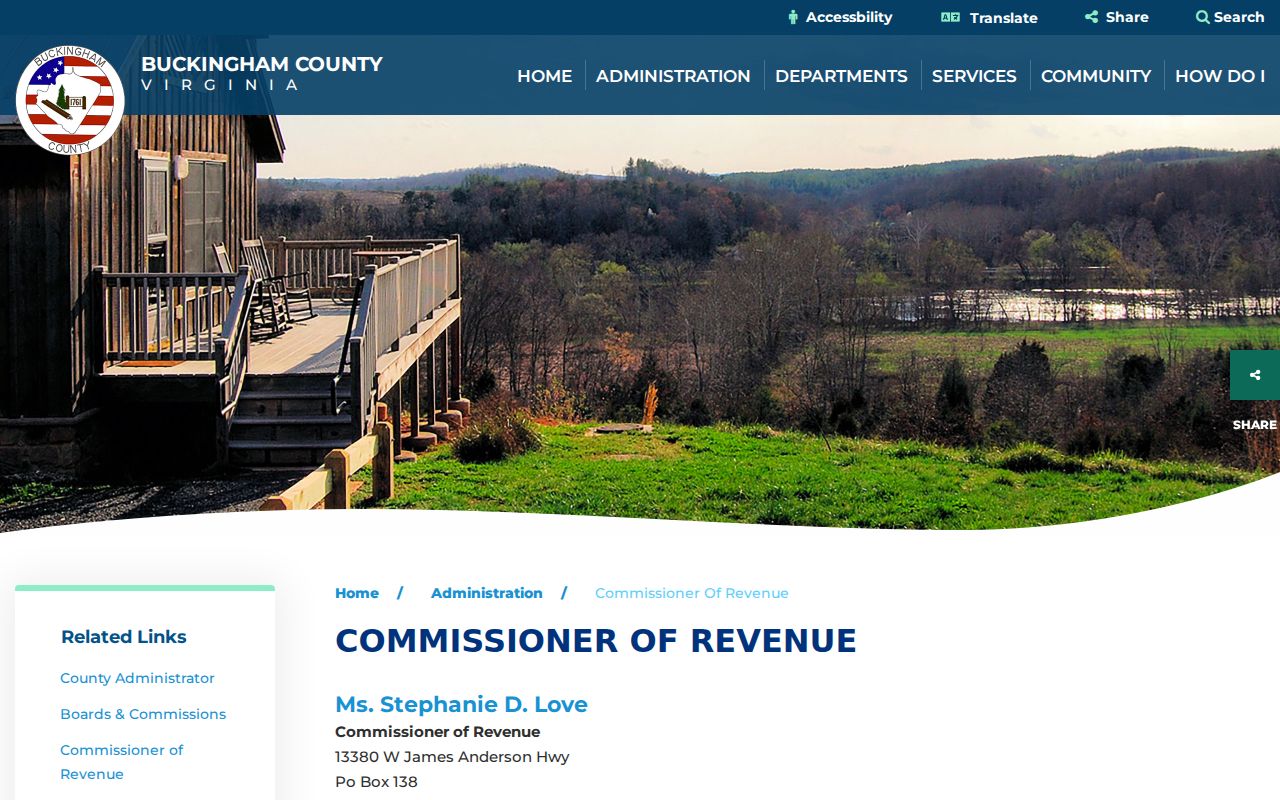
The screen documents the assessment office but does not display an individual property's value.
Look Up a Buckingham Assessment
Start with the parcel number. Then ask the Commissioner what value is recorded for that year. No public form displays live assessment fields. A map lookup finds the parcel, and the office confirms the amount. Keep the year attached to the number. A value without a year is nearly impossible to compare against another parcel or an earlier tax roll.
- Locate the parcel in the Buckingham GIS entry and copy its Map# or PIN if displayed.
- Ask the Commissioner for the assessment amount and tax year tied to that parcel.
- If comparing a sale, ask the Circuit Clerk for the latest recorded deed and its consideration details.
- For a bill amount, switch to the Treasurer because the tax account is a separate record.
- Assessed value
- The local value used in property-tax calculation.
- Market value
- An estimate of what a property could sell for under current conditions.
- Consideration
- Value or payment associated with a deed transfer; read the instrument context.
- Assessment ratio
- A comparison of assessed and market value; no Buckingham ratio was located.
- Reassessment
- A change to the assessed record; the county's cycle was not published.
Buckingham's Rate Is Not a Sale Price
Buckingham's published 2026 real-estate rate is $0.60 per $100 of assessed value. The rate applies to the assessment. It says nothing about market worth. It reveals no recent sale price either. Multiplying the rate by an assessment can help explain a tax bill. The Treasurer's account remains the source for what is currently due. Installment dates, processor fees, exemptions, and balances belong elsewhere. That separate Buckingham property tax records page covers them. Here the point is simpler. A value means one thing, and its source record tells you which.
Recorded Buckingham Sales Have a Deed
A recorded sale in Buckingham lives in the deed. Read the price with the parties. Read it with the date and legal description too. The county publishes no searchable last-sale field on the assessor side. A map or assessment page can locate the parcel, but the Circuit Court Clerk is the local recorder of deeds. Consideration does not always equal present worth. Transfers can be gifts, estate distributions, or deals between relatives. None of those matches an ordinary market sale. For a real market estimate, hire a qualified appraiser instead of copying the tax roll or trusting an old deed price. Buckingham Circuit Court Clerk land records are the source for recorded deeds.
Buckingham Land Books Give Older Context
The Library of Virginia holds Buckingham land books for 1930 and 1931. Its 2024 courthouse inventory report also notes an 1859 land-tax book. That book contains a folded 1834 volume. Old land books show an earlier tax-era view of land and its holder. They are not a modern appraisal. They skip many years entirely. The 1869 fire destroyed county records. Older evidence may survive in survey books, parent-county records, or loose papers that need authentication. Match a tract by description, adjoining land, and survey calls before linking it to a current parcel. The LVA inventory account identifies the unusual book find.
Relief Can Change the Tax Treatment
The Commissioner posts elderly and disabled tax-stabilization forms. A disabled-veteran affidavit appears there too. These papers change tax treatment, not market value. The county publishes them as PDFs that cannot be submitted electronically, and no full eligibility schedule or online exemption flag appears. Read the current form and ask the office how approval changes the tax account. A lower bill does not mean the assessment fell. Value questions belong with the Commissioner; payment questions belong with the Treasurer. Keeping the two records separate makes year-to-year comparisons far clearer.
Use Buckingham's 2026 Rate as a Tax Check
Buckingham's 2026 real-estate rate is $0.60 per $100 of assessed value. A $150,000 assessment would owe $900 in county real-estate tax before relief or account adjustments. That is tax math, not valuation. It says nothing about sale price. Nor does a matching bill mean matching land. Two parcels taxed alike can differ in size, condition, and market appeal, so the arithmetic cannot predict what either would fetch.
Keep rate and assessment years aligned. A mismatched pair quietly distorts the result. Check the Treasurer's bill for charges, payments, and credits. Assessment questions go to the Commissioner; balance and payment status go to the Treasurer. Buckingham publishes no assessment ratio, no stated reassessment cycle, and no parcel-level online value history, so a rate calculation cannot fill those gaps.
Compare a Buckingham Sale With Its Deed
A recorded deed proves an interest transferred on a certain date. It does not automatically state a market price. The consideration may reflect a gift, a family transfer, an estate, a partial interest, or terms a simple index entry never shows. Read the parties first. Then check the legal description, instrument type, and any related deed of trust or release. Only then treat a number as a market clue.
Buckingham offers no public sales-comparison portal, no verified recent-sale field, and no town-level trend series. Deed records establish context, not a one-number market estimate. A qualified appraiser weighs condition, acreage, improvements, access, and comparable transactions that a tax record or remote map misses. That professional step matters for real valuation work. The Circuit Clerk is the custodian for recorded deeds.
Read Old Buckingham Land Books as Snapshots
The Library of Virginia lists Buckingham land books for 1930 and 1931. It also reports a loose 1859 land-tax book holding an 1834 volume. They place a tract in an earlier tax period. They do not form a continuous annual value series. Names, acreage, and boundaries shift over time. Match a historic entry to a current tract through deeds, surveys, adjoining owners, and road or watercourse descriptions.
The 1869 fire complicates the paper trail. Survey books and plats still preserve geographic clues from earlier periods. Cite a historic assessment with its year and archive. Never present it as a current estimate. The LVA's 2024 inventory account describes the loose holdings and helps target an archival question; browse the LVA's Buckingham record inventory for the full listing.
Ask Buckingham for the Assessment Year
Some tax notices never state their effective year. Ask the Commissioner instead. Request the assessment attached to the parcel and the tax year it represents. Include the Map# or PIN, situs address, the year in question, and the source where you saw the amount. Ask whether the value covers land only, improvements only, or total real estate. Public pages vary in which fields a parcel result exposes.
The Commissioner also publishes elderly and disabled tax-stabilization forms plus a disabled-veteran affidavit. The county says those applications are PDFs only. Electronic filing is not offered. Relief changes tax treatment, not market value. For an assessment review, ask the office about the local process and deadline. The published pages state no appeal calendar.
Limits of a Buckingham Property Value
A Buckingham assessment is a tax record. It is not a sale-price promise or a professional appraisal. The county publishes no local assessment ratio, no reassessment cycle, and no live value history. A sale number can be historical. It can also reflect a transfer that is not a typical market deal. Attach the source, date, and purpose to every number.
Value vs price. The Buckingham assessed amount serves taxation and is not what the property will sell for. Use a licensed appraiser for a market-value opinion.